Labels

4K UltraHD (154) 88 Films (255) Acorn Media (86) AGFA (American Genre Film Archive) (22) Altered Innocence (4) Alternative CInema (1) American Independent Film (1) Anchor Bay Entertainment (14) Andrzej Zulawski (1) Animation (1) Arrow Academy (14) Arrow Films (48) Arrow Video (258) Arthouse Horror (5) Artificial Eye (24) Big World Pictures (13) Blog Review (12) Blu-Ray (2291) Blue Underground (56) Breaking Glass Pictures (67) British Film Institute (BFI) (5) British Horror (5) Bruno Mattei (1) Cannon Films (1) Cauldron Films (12) Celluloid Dreams (5) Charles Band (6) Chelsea Films (6) Cinedigm (13) Cinema Libre (17) Cinephobia Releasing (3) Cleopatra Records (1) Code Red Releasing (91) Cozy Mystery (10) Criterion Collection (3) Cult Epics (44) Cult Films (4) Czech Surrealism (4) Dark Force Entertainment (6) Dark Star Pictures (1) Deaf Crocodile (11) Disney (5) Dorado Films (1) Dread (1) DTV Erotica (3) DVD Drive-In (1422) DVDBeaver (854) DVDCompare (1432) Empire Pictures (3) Entertainment One (6) Epic Pictures (1) Eureka Video (230) Film Chest (6) Film Detective (The) (16) Film Masters (10) Film Movement (135) First Run Features (2) Flicker Alley (2) Found Footage (1) French Erotica (2) French Horror (1) French Noir (7) Full Moon Entertainment (57) Fun City Editions (6) Garagehouse Pictures (7) Gay/Lesbian Interest (3) German Horror (3) Golden Harvest (8) Gorgon Video (5) Grindhouse Releasing (10) Hong Kong Horror (3) Hong Kong Martial Arts (22) Icarus Films (2) Icon Entertainment (6) IFC (1) Ignite Films (2) Image Entertainment (8) Impulse Pictures (17) Inception Media Group (5) Indicator (1) IndiePix (17) Indomina Films (5) Intervision Picture Corp. (29) Istvan Szabo (1) Italian Action (3) Italian Crime (4) Italian Erotica (16) Italian Giallo (7) Italian Horror (14) Jackie Chan (9) Japanese Action (5) Japanese Arthouse (9) Japanese Erotica (2) Japanese Horror (5) Jean-Claude Van Damme (3) Jess Franco (55) Jinga Films (7) Joe D'Amato (18) Kimstim (1) Kino Lorber (186) Larry Cohen (1) LGBTQ+ (50) Lightyear Entertainment (3) LionsGate (57) Lovelockandload (3) Magnolia Pictures (8) Maltauro Entertainment (2) Martial Arts (3) Masters of Cinema (85) Mediumrare Entertainment (1) MGM (9) Midnight Releasing (2) Mill Creek Entertainment (3) Momentum Pictures (14) Mondo Macabro (51) MPI Home Video (6) Mr. Bongo (4) MTI Home Video (11) Music Box Films (3) MVD Visual (571) MVM (4) Neo-Noir (2) Neon Eagle Video (1) Network (3) Nikkatsu (1) Nordic Noir (1) Nucleus Films (9) Olaf Ittenbach (1) Olive Films (12) Oscilloscope Laboratories (4) Ozploitation (1) Panik House (3) Paramount Pictures (34) Polish Arthouse (1) Polyscope Media Group (3) Powerhouse Films (1) Radiance Films (97) Raro Video (52) Red Shirt Home Video (1) Redemption Films (28) Retro Review (3) Retromedia (11) Revolver Entertainment (16) RLJ Entertainment (21) Roger Corman (2) Ronin Flix (36) Rustblade Records (2) Sammo Hung (2) Scorpion Releasing (163) Scream Factory (141) Screen Media (2) Screenbound (7) Second Run DVD (117) Second Sight (72) Severin Films (181) Shameless Screen Entertainment (12) Shaw Brothers (4) Shout Factory (175) Shudder (24) Signature Entertainment (1) Silent Film (1) Simply Media (33) slasher (8) Something Weird Video (4) Sony Entertainment (11) SOV Erotica (1) SOV Horror (2) Soviet Cinema (1) Spanish Horror (1) Stephen King (1) Strand Releasing (90) Stuart Gordon (1) Sub Rosa Studios (SRS) (1) Synapse Films (54) Takashi Miike (2) Tartan Films (14) Time Life (4) Tinto Brass (9) TLA Releasing (10) Troma Films (10) TV Horror (1) Twentieth Century Fox (9) Twilight Time (2) Umbrella Entertainment (69) Unearthed Films (30) Universal Pictures (17) VCI Home Video (19) Vestron Video (7) Videonomicon (2) Vinegar Syndrome (375) Vintage Erotica (7) Vintage Television (1) Visual Vengeance (7) Warner Archive (12) Warner Home Video (3) Well Go USA (19) Wes Craven (1) Wild Eye Releasing (27) Wolfe Video (23) Yakuza (2) Yellow Bag Films (2)
Showing posts with label Blog Review. Show all posts

17 July 2023

Powerhouse Films and Indicator experience THE SHIVER OF THE VAMPIRES (review)

Hippie vampires have plans for a virginal bride when newlyweds visit an ancestral castle in Jean Rollin's THE SHIVER OF THE VAMPIRES.

REVIEW LINK: Powerhouse Films (US/UK) 4K UltraHD (CineVentures Blog)

THE SHIVER OF THE VAMPIRES 4K UltraHD specs:

  • 2160p24 HEVC 1.66:1 Widescreen
  • French and English LPCM 2.0 Mono
  • Optional English and English SDH Subtitles
  • Audio Commentary by director Jean Rollin
  • Audio Commentary by film historian Jeremy Richey
  • 1998 Introduction by director Jean Rollin
  • "Rouge Vif" updated documentary featuring interviews with actress/costume designer Natalie Perrey and assistant director Jean-Noël Delamarre
  • "Fear and Desire" 2004 interview with director Jean Rollin by Patricia MacCormack
  • "Macabre Psychedelia: Virginie Sélavy on THE SHIVER OF THE VAMPIRES"
  • Export Sex Scenes
  • French Theatrical Trailer
  • English Theatrical Trailer
  • Image Galleries
  • Limited edition of 3,000 Copies.
  • Comes with an 80-page book with a new essay by David Hinds, an archival introduction by Jean Rollin, an archival interview with the director by Peter Blumenstock, an archival interview with actor Marie-Pierre Castel, Andy Votel on Acanthus, the mysterious group behind the film’s soundtrack, and full film credits.


Also available on Blu-ray:


30 May 2023

RETRO REVIEW: try not to snore on THE STAY AWAKE

THE STAY AWAKE (John Bernard, 1989) 

In the fifties, American serial killer William John Brown (Lindsay Reardon, DIAMOND IN THE ROUGH) is executed for multiple rapes and murders of young women. He claims to be the Angel of Darkness and will have his revenge from beyond the grave. Thirty years later at St. Mary's private girls' school somewhere in Europe after the term, a roving Steadicam POV starts wandering the corridors on the night that the remaining girls and their teacher Miss Walton (Shirley Jane Harris, THE RETURN OF THE FAMILY MAN) schedule a stay awake in the gym to raise charity funds. 

The evil presence breaks a beakers in classrooms and makes just enough noise for Miss Walton to alert groundskeeper Mr. Stark (Ken Marshall, THE GODS MUST BE CRAZY II) to the presence of a prowler, but the girls remain largely oblivious as do aerobics – the throwaway reference to Jamie Lee Curtis seeming to have more to do with her eighties fitness image than as a HALLOWEEN final girl – play lame pranks, shower, and run off to meet boys who have snuck onto the grounds. Eventually the evil presence tires of wandering around and shows itself as a Halloween store demon that starts killing the cast through telekinetic means until only one remains.

An early Avi Lerner/Nu Image credit from the South Africa tax shelter days when a few local films were also able to take advantage of free government money raked in by foreign productions like the various Cannon Films, 21st Century Film Corporation, Allied Vision, and Breton Film Productions, Ltd. productions like the back-to-back AMERICAN NINJA 2 and AMERICAN NINJA 3, RIVER OF DEATH, PLATOON LEADER, TEN LITTLE INDIANS, HOWLING IV: THE ORIGINAL NIGHTMARE, THE HOUSE OF USHER, BURIED ALIVE, and THE MASQUE OF THE RED DEATH (from which this film's Christobel D'Orthez is the only recognizable cast member among the students). Unlike the equally budget-deprived by ambitious and transgressive South African contemporary THE SHADOWED MIND – which was actually banned – THE STAY AWAKE is almost feeble in its plotting and execution (probably the closest modern equivalent might be the Paris Hilton Scottish-set/England-lensed horror NINE LIVES); had it been made these days on this level with state funds, one would wonder if most of the money had been laundered. 

The William John Brown scene appears to have been tacked on, not only because it is more visually-stylish than the rest of the film – intercutting the killer's walk to the gas chamber with slow-motion cutaways to his crime scenes under investigation to the tune of a fifties-style ballad – but there seems to be nothing to connect the killer to the students of a European private Catholic girls' school and the actual onscreen monster is a lame puppet demon (additional cutaways to Brown with poorly-aligned optical red eyes could just as easily have been added in post). The rest of the film is interminable banter between the catty girls, wandering around corridor sets, and endless Steadicam shots – alleviated by a couple crane shots of the exterior of the Gothic campus of which only the gymnasium seems to truly belong – to groaning synth music and demonic laughter. The in-camera effects are modest – as is the cheesecake shower sequence – the gore is minimal, and the whole thing ends with a freeze frame and a warbly pop song. As bad as THE STAY AWAKE is, I would probably still snap it up on Blu-ray if only to see how the film looks stripped of its dark and hazy video mastered defects. 

The film was released on VHS by Nelson Entertainment and on DVD by Image Entertainment (out of print and ridiculously expensive when it pops up). The most economic physical media option is importing the German DVD which has remained affordable since it has been re-pressed a number of times with different covers (the French DVD only includes the French-language dub). I would avoid the unauthorized Cheezy Flicks DVD on principle. For the curious, THE STAY AWAKE is currently streaming on Tubi via current rights owner Filmrise (although not from their own streaming service). 

18 July 2022

RETRO REVIEW: Enter THE BLACK ROOM

THE BLACK ROOM
(Elly Kenner and Norman Thaddeus Vane, 1984)
USA

The original text of this review appeared on the now-defunct film website EsotikaFilm in 2008.  It has been slightly revised here while the original can be accessed via the above Wayback link.

 
Larry (HOSPITAL MASSACRE's Jimmy Stathis) is a thirty-something husband and father looking for a place to cheat. He finds an ad in the newspaper for a room for rent in a mansion in the Hollywood Hills owned by a mysterious photographer Jason (Stephen Knight) and his ethereal sister Bridget (NIGHT SHIFT's Cassandra Gaviola). The room for rent is the titular "black room" with mirrored walls, dark furnishings, and black walls with the only light sources being candles and a glowing glass table. Larry starts taking girls there and having sex, not knowing that Jason and Bridget are watching and photographing them through one of the room's two-way mirrors.

When Larry goes home to his wife and kids, he uses the details of his supposedly imaginary encounters to spice up him and his wife's sex life.  The girls, however, unbeknownst to Larry, are unwillingly providing blood transfusions to keep Jason's blood disease under control. Thinking that Larry could be a lucrative source for fresh blood, Bridget seduces him in the black room and Jason photographs it for blackmail purposes. When Larry's wife Robin (Clara Perryman) finds the newspaper ad about the room for rent in Larry's car, she visits the mansion and discovers the room is real, that Larry must really be cheating on her, and things take an unusual turn…

Ostensibly a horror film, THE BLACK ROOM is more concerned with the ambiguous nature of human relationships than the subplot of busty gals having sex and being killed in a remote horror house. Our protagonist is a husband and father with a cheerful home-life that becomes complicated in the bedroom with children who will not go to sleep, having to be quiet to not wake them when they do, and the general staleness of his marriage. He uses his encounters with other women in the black room to heat up his sex life with his wife; referring to them as "word pictures."

The encounters with various women in the black room are not excuses for T&A as the chiaroscuro lighting does not allow for that nor does the editing. The focus within the room is on Larry exploring himself psychologically with character-probing small-talk as foreplay.  The voyeuristic brother and sister are depicted in the act of looking rather than showing us what they are looking at. Even Bridget's nudity during her encounter with Larry is obscured by the artful body paint with which she coats herself and Larry.

Robin's discovery of the black room does not lead to a stalk-and-kill scene. A sinister-looking Jason finds Robin sitting in the garden and they speak frankly about Larry's activities and Jason's and Bridget's roles in the arrangement. He even shows Robin the two-way mirror and snaps photographs while Larry has sex with another woman and Robin cries on the sofa. Jason's suggestion that Robin turn the tables on Larry and make use of the black room as well for her pleasure seems less motivated by the opportunity to procure fresh victims than as an erotic diversion; making the bloodthirsty sibling set seem less single-minded than they would be in a more straightforward horror film. The black room itself is an enclosed setting that allows for interior exploration, experimentation, and improvisation – signified by the camerawork which glides back and forth between the onscreen light sources and complete blackness only to come across more candles or indistinct bodies writhing either in passion or in terror as the syringe and chloroform-wielding brother and sister approach – where Larry and Bridget can step outside themselves even as afternoon partners try to deduct their personalities.

Extraordinarily for an American independent film, neither the staging of long sequences in the black room or the mansion and its grounds nor the rushed and cramped nature of the exterior shooting make the film feel stage- or set-bound precisely because of the film's Pinter-like association of interior lives with interior spaces and the threats of intrusion from without and the greater one from within. Of course, it does eventually lead to the obligatory stalk-and-kill sequence with HALLOWEEN shadings involving butcher knives, closets, a coat-hanger impaling, and "he's not dead yet!" surprises – featuring an atypically clothed and non-screaming Linnea Quigley (RETURN OF THE LIVING DEAD) – and a circular ending. What we have here is a low-budget, independent arthouse picture masquerading as a horror film.  Had this film been made in Europe in the seventies it would be a piece of prime Eurocult with added nudity. Had it been made more recently in Europe, it would be an edgy art film. Had it been made in the nineties in the states, it would have been an DTV "erotic thriller" bogged down by lingering, slow-motion, scored with somnambulant sax and keyboard with an added horror tinge not unlike Fred Olen Ray's usually diverting twists on the genre.  Christopher MacDonald (THE EIGHTEENTH ANGEL) also has a supporting role in the film and merits an "and – as" screen credit in the opening titles.

RETRO REVIEW: Alain Robbe-Grillet visits THE BLUE VILLA

THE BLUE VILLA aka UN BRUIT QUI REND FOU
(Dimitri de Clercq and Alain Robbe-Grillet, 1995)
France/Belgium/Switzerland

The original text of this review appeared on the now-defunct film website EsotikaFilm in 2008 and was published shortly before Alain Robbe-Grillet's death in February of that year.  It has been slightly revised here while the original can be accessed via the above Wayback link.

"But debts to the dead are sacred here."

A year to the day of the mysterious death of his stepdaughter Santa (Sandrine Le Berre) at the hands of her lover Frank (Fred Ward), screenwriter Eduoard Nordmann (Charles Tordjman) begins a screenplay framing the crime in the context of a local myth about a mariner destined to return every year to the place of his crime in search of redemption. He is subsequently informed by Inspector Thieu (Dimitris Koulikakos) that Frank – thought to have drowned during his flight from the crime scene by boat – or his ghost, has been seen all over town by the locals. Although Thieu identified an unidentifiable body found at the time as that of Frank, he never truly believed the story behind Santa's death and intimates his suspicion of Nordmann's involvement since he would benefit from her death by inheriting the money left to Santa by her late mother.

Little do either of them know that Santa is in fact alive and being cloistered in the island's local gambling house/bordello, The Blue Villa, under the care of Madame-smuggler-extortionist-pimp Sarah-Le-Blonde (Arielle Dombasle who later appeared in Robbe-Grillet's GRADIVA). Thieu informs Nordmann that Santa's real father (Christian Maillet, the film is dedicated to the late actor) has had his daughter's case reopened and is told not to leave the island until the investigation is completed. Nordmann endures ghostly appearances by both Santa, who reproaches him for his molestation of her, and Frank who tells Nordmann that he has come back from the grave to collect his debt. Is he really being haunted or is he the victim of a plot?

THE BLUE VILLA is the popular English title of the film. The French title actually translates as "A Noise That Drives One Mad" referring to the clattering of shuffling ivory mah-jong tiles that Nordmann claims can drive a man to madness. Co-directed by Dimitri De Clerq (and produced by Jacques De Clerq) – who later produced the unsubtle Georges Bataille adaptation MA MÈRE – this is perhaps Robbe-Grillet's most accessible film (even more so than the even more mainstream PLAYING WITH FIRE in which the tension between father and daughter was more overtly incestuous).

There is the Robbe-Grillet trademark use of disorienting sound effects but here they are oddly complementary to the action in an unconventional manner. Sounds of helicopters and gunfire that sound like the soundtrack of another film bleeding into this film's soundtrack actually underline Thieu's comment on the death of Nordmann's wife who was killed in Indonesia by revolutionaries. The sounds of a typewriter underline an expository scene between Sarah and Thieu at which the writer is not present suggesting these scenes may be imagined by Nordmann's paranoid creative mind.

The imposition of competing narrative structures upon a series of events is the focus of this film. Nordmann first superimposes the local legend of the pale mariner on the crime ("Last year a driller calling himself Frank fit the part…") to suggest the inevitability of his stepdaughter's demise. He also attempts to revise facts in the dialogue, claiming to have loved "his only child" only to be corrected by Thieu that not only was she not his biological child but he was known to have hated her. As suspicious falls upon him, Nordmann not only possibly imagines aspects of Thieu's investigation and the machinations of Sarah and Santa's real father, he also revises the possible series of events leading to his daughter's death while skirting the details of his own involvement. He even conjectures an accidental death version after encountering Frank's apparition as if to placate the vengeful spirit.

In the form of police reports, Thieu narrates possible theories and picks them apart trying to fit Nordmann's involvement into the series of events. Added onto all of this is another layer in which Santa's real father appears to be narrating Eduoard's haunting and paranoia. Regardless of whether Frank and Santa are truly alive or not, they are specters of a sort as they both (literally on Frank's part) stroll through the narrative which is shaped and reshaped around them (neither Ward nor Le Berre have much dialogue until the final third of the film). They are, however, given the privilege of erasing Nordmann's story.

Although the plot is film noir, the film's visual style emulates that genre but reaches back to its German Expressionist forbears. Frank is followed around wherever he goes by three musicians. In later scenes, their presence suggests Frank's ghostly presence even when he does not appear. In one such scene, Nordmann encounters their VAMPYR-like disembodied shadows. Throughout the film, Sarah teaches a song about the island's legend of the pale mariner to Santa. Sarah is later seen performing the song at the Blue Villa's salon to the accompaniment of the same three musicians. Menacing shadows suggest supernatural vengeance even though Nordmann believes he has just as much to fear from the police and Blue Villa owner Mars' thugs. The apparitions of Santa that appear to Nordmann are theatrically staged – appropriately since we know she's really alive, even if the conspiracy is a figment of Nordmann's paranoid imagination – with lighting effects (in one, she simply steps in front of a window as a spotlight comes up to reveal her to Nordmann).

Ward seems an odd choice for the role of Frank. Although he has proven to be one of those ageless actors, he is still obviously a few decades older than the seventeen-year-old Santa. As effective as Ward is, he also seems more like a commercial concession – possibly on the part of the De Clerq's – and most of his non-dialogue scenes almost have a second-unit location photography feel to them. An unknown probably would've been a better match for Le Barre's cipher. Dombasle is a striking and charismatic presence but, like similarly arresting LA BELLE CAPTIVE's Sarah Zeitgeist (Cyrielle Clare), she is given little depth. While it is not surprising that even the principle female (Le Barre) in a Robbe-Grillet film is only rendered in superficial shades, what one finds lacking here is the sort of bewitching, bewildering eternal female figure one expects from a Robbe-Grillet work like L'IMMORTELLE. Perhaps, then, it makes sense that the story that Nordmann and Thieu are attempting to contain within a narrative leans more heavily towards - quite literally - a plot than the supernatural.

The island setting and the shabby environs are effectively realized; an early scene of a fainted prostitute surrounded by superstitious patrons in the Blue Villa's bar recalls the tense tavern scenes of Jean Rollin's LES DEMONIAQUES as much as LA BELLE CAPTIVE's mansion scene recalls the look and feel of a similar scene in Rollin's LE VAMPIRE NUE (there is a tenuous link there worth exploring by someone). The Blue Villa, which Nordmann describes the name as possibly "in memory of a famous bordello for well-heeled degenerates in Hong Kong" recalls Robbe-Grillet's "La Maison De Rendez-Vous" ("probably imaginary, that too," Nordmann adds). Santa's bordello cell – along with the rest of the Blue Villa – also recall the environs of PLAYING WITH FIRE while her pure white bedroom in Nordmann's house recalls the cell of SUCCESSIVE SLIDINGS OF PLEASURE. Some of the island imagery, including a shot of a man sitting in a chair along the waterfront directly references L'IMMORTELLE.

The Jacqueline Pierreux credited as one of the coproducers is not the actress mother of Jean-Pierre Leaud. Cinematography, production design, and costumes are typically top-notch; perhaps too perfect as they lack the distantiating rough edges of Robbe-Grillet's earlier work. Nikos Kypourgos' score is exotic but, once again, seems a bit too refined for a Robbe-Grillet film. Sound was recorded by Francois Musy (Godard's PASSION, HAIL MARY, DETECTIVE, etc). The film was shot in Panavision (2.35:1) – a lot of the setups are static but well-composed and effectively framed with gels, shadows, and Oriental set dressing. The Dolby Stereo soundtrack is thunderous when it needs to be and stereo could perhaps provide Robbe-Grillet with an interesting medium for his use of sound effects as counterpoint to onscreen action should he write and direct another film.

05 July 2022

Arrow Video presides over THE INITIATION OF SARAH (blog review)

If you though hazing was tough, you  could lose your soul when you take part in THE INITIATION OF SARAH, on Blu-ray from Arrow Video.

Dowdy – well, Hollywood dowdy – orphan Sarah (Kay Lenz, MOVING VIOLATION) is ignored in favor of her prettier sister Patty (Morgan Brittany, TV's DALLAS), even by their mother (Kathryn Grant, ANATOMY OF A MURDER) who is excited about the likelihood of biological daughter getting into Waltham College's elite Alpha Sigma Nu. The two freshman coeds tour the sorority houses and Patty is handpicked by Alpha Sigma Nu president Jennifer (Morgan Fairchild, THE SEDUCTION), who also indirectly suggests Sarah should pledge rival house PED ("Pigs, Elephants, and Dogs").

Sarah does indeed find herself mysteriously drawn to the Pie Epsilon Delta – whose housemother Mrs. Hunter (Shelley Winters, WHOEVER SLEW AUNTIE ROO?) also teaches courses in magic practices of primitive peoples – who do not participate in pledging or initiations and tell Sarah to leave her name if she wants to join. ANS is one of a number of houses that ask Patty to pledge while PED is the only one that asks Sarah. Jennifer starts driving a wedge in between Sarah and Patty by forbidding the pledge's association with the rival sorority; but Mrs. Hunter not only offers insight into Sarah's past but also offers a means of controlling her powers that create CARRIE-esque telekinetic mayhem whenever she is angered.

Although teaching assistant Paul (Tony Bill, CASTLE KEEP) does not believe in Sarah's powers, he is suspicious of Mrs. Hunter whose rivalry with Alpha Sigma Nu dates back twenty years to the death of a pledge during an initiation ritual with a special twist. As Sarah tries to band her unpopular sisters together in solidary (including ZOMBIE's Tisa Farrow and CRAWLSPACE's Talia Balsam), she becomes more self-confident. When she publicly calls Jennifer out on her bullying behavior – combined with a psychic shove into the fountain – Sarah becomes the prime target of ANS' beef with PED.  Unfortunately for ANS, Mrs. Hunter is teaching Sarah how to focus her powers towards vengeful ends and her own coming initiation requires a special sacrifice.

Although THE INIATION OF SARAH could perhaps be likened to producer Charles Fries' variation on rival TV producer Aaron Spelling's SATAN'S SCHOOL FOR GIRLS, it – along with Fries' THE SPELL – is far more indebted to Brian De Palma's film adaptation of CARRIE from a cruel prank that unleashes Sarah's telekinetic fury to the successive jump cut tilted close-ups of Lenz that prefigure her attacks. Although it makes some interesting parallels between sororities and cults – including the climactic intercutting of the two sororities equally sinister ritual which both require a show of blind faith by the pledges – it seems as though large chunks of the narrative are missing, either never scripted by episodic TV scribes Don Ingalls and Carol Saraceno (from a story by FRIGHT NIGHT's Tom Holland) and mentioned in passing, or cut down for a workable running time for a two hour slot (at ninety-seven minutes, it's already about twenty minutes longer than most of Spelling's equivalent 1970s horror entries which were destined for ninety-minute slots).

The unknown identity of Sarah's mother seems of some importance to the story but is dropped and the story seems to leap forward by large bounds at a time with characters remarking more on the changes in Sarah's character than the viewer is shown.  We also never learn much about the basis of the rivalry between the sororities and the ritual-gone-wrong, making it seem like a case of mean girls with a long-standing grudge. None of the scares are actually chilling but the film maintains its dramatic tension and has an okay atmosphere.

The cast is a bit long-in-the-tooth for college students – the same year, Bill would play the burnt-out father of a teenage rape victim in the Fries-produced TV movie ARE YOU IN THE HOUSE ALONE? and Robert Hays (who plays Fairchild's boyfriend) was just two years away from playing the shell-shocked ex-pilot in the uproarious AIRPLANE! –  but Lenz does her best with a script full of holes, Fairchild is appropriately bitchy, and Brittany suitably conflicted (Winters is the only one that seems to be phoning it in). CARRIE's Michael Talbott appears briefly as another frat brother. Composer Johnny Harris (FRAGMENT OF FEAR) would follow this assignment up with Gus Trikonis' THE EVIL  The film was remade for ABC TV for Halloween 2006 with DAWSON'S CREEK's Mika Boorem and TERMINATOR: THE SARAH CONNOR CHRONICLES' Summer Glau as the sisters, and BRIDE OF CHUCKY's Jennifer Tilly replacing Winters.

THE INITIATION OF SARAH hit home video in the 1980s via WorldVision Home Video, but it was through MGM's acquisition of the Fries library that Scream Factory has brought it to DVD in a double feature with ARE YOU IN THE HOUSE ALONE? (itself subsequently upgraded to Blu-ray as part of Vinegar Syndrome's TELEVISED TERRROR COLLECTION VOL. 1). While the DVD featured an interlaced transfer from the broadcast video master, Arrow Video's Blu-ray is derived from a new 2K restoration of the film's original camera negative.  Colors are vibrant but lean towards the naturalistic in terms of grading.  The garden maze miniature looks even more unconvincing in HD but the make-up appliances to Fairchild during the climax hold up surprisingly well (perhaps better with the greater visible detail over the old video master where it looked rather slapdash).  There is some moments of coarseness and softness baked into the seventies opticals, but gone is the overall dreamy veil of the video masters which tended to make a lot of the film look as though it were shot with the sort of diffusion filmmakers utilized during the seventies and eighties on sunny exterior sequences.  The DTS-HD Master Audio 1.0 track more than adequately renders the original mono mix which was not particularly ambitious even in its supernatural sequences, best serving the fidelity of the score.  Optional English SDH subtitles are also included.

Extras start off with an audio commentary by TV Movie expert Amanda Reyes – editor of ARE YOU IN THE HOUSE ALONE? A TV MOVIE COMPENDIUM: 1964-1999 – who has provided commentary and visual essays on Blu-ray releases of the TV genre films DON'T BE AFRAID OF THE DARK, THE VICTIM, NIGHT TERROR, as well as ARE YOU IN THE HOUSE ALONE?, CALENDAR GIRL MURDERS, and CHILD IN THE NIGHT, the three films that comprise Vinegar Syndrome's aforementioned TELEVISED TERROR: VOLUME 1.  She discusses the target demographic of TV movies as women in the home 18-49 reflected in anxieties and concerns over family, second wave feminism, and salacious topical subjects, as well as the greater scrutiny of films in the TV season that THE INITIATION OF SARAH played following reactions to the sexual and violent content of the Linda Blair-in-juvenile detention TV movie BORN INNOCENT along with criticisms of "jiggle TV" like THREE'S COMPANY.  Reyes also highlights the showbiz family connections of several of the cast members including Balsam, Farrow, Nora Heflin – niece of Van Heflin – Grant, then-widow of Bing Crosby for whom the film was billed as her comeback (although she would not make another film appearance until 2010's QUEEN OF THE LOT).

"Welcome to Hell Week: A Pledge's Guide to The Initiation of Sarah" (16:33) is an appreciation by film critic Stacie Ponder and Queer Horror programmer Anthony Hudson, co-hosts of the "Gaylords of Darkness" podcast, who make a campy case for why queer audiences would relate to and read in to films in which an apparently heterosexual protagonist is "othered" as well as elements of sublimated lesbian sexuality that seem more obvious in the "smitten" friendship between Sarah and Mouse.

"Cracks in the Sisterhood: Second Wave Feminism and THE INITIATION OF SARAH" (14:48) is a visual essay by film critic and historian Alexandra Heller-Nicholas in which she looks at the tensions of different factions of the feminist movement brimming under a "popcorn revenge movie", and the multiple meanings of sisterhood in the film including who is an ally and who is working in their own interests drawing comparisons between Hunter and Jennifer as both exploiting the notion of unity among women in contrast to Sarah's plea to her sisters that they "be nicer to each other" and to themselves.

"The Intimations of Sarah" (16:19) is an interview with film critic Samantha McLaren who suggests that the film is not a knockoff of CARRIE but a project reshaped following the success of that film and, thus, informed by it.  She moves beyond the surface comparisons to the film's themes and symbolism including the maze and its associations of death and rebirth, queer themes, and the witch as a transgressive but not always evil figure.

In "The Initiation of Tom" (8:58), screenwriter Tom Holland recalls getting into stage acting, landing a contract with Warner Bros., wanting to direct and finding screenwriting a more fulfilling compromise than acting, and his original story for THE INITIATION OF SARAH that had Sarah turning her enemies into barnyard animals.  He then recalls being in demand for genre work but having the success of his first feature screenplay THE BEAST WITHIN – following an aborted first attempt at adapting FLOWERS IN THE ATTIC without the incest – overshadowed by the collapse of United Artists.  Since the interview only focuses on his work as a screenwriter, it concludes with a brief discussion of his screenplay for PSYCHO II.  The disc closes with an image gallery.

Not provided for review were the reversible cover featuring newly commissioned artwork by Luke Insect or the fully-illustrated collector's booklet featuring new writing by Lindsay Hallam and Alexandra West (included with the first pressing only).

29 June 2022

Arrow Video teeters on the EDGE OF SANITY (review)

It's "double the terror, double the fun" when Anthony Perkins trades Mrs. Bates for Mr. Hyde in EDGE OF SANITY!

Sexually repressed since his traumatic Freudian childhood experience of his father's infidelity with a prostitute, Henry Jekyll (Anthony Perkins, PSYCHO) has grown into a respected London physician as devoted to his practice as his wife Elizabeth (Glynis Barber, TERROR) is to her charities in London's East End. Experimenting with concentrations of cocaine as a more effective anesthetic than morphine, Jekyll has also been using the compound as a stimulant which he claims makes him feel exhilarated and euphoric. 

One night, however, Jekyll inadvertently inhales the fumes of an accidental chemical reaction and unleashes his repressed self in the form of Jack Hyde, who is a much snazzier dresser and lacks the good doctor's limp. Swaggering down to London's East End, he catches the eye of hustler Johnny (Ben Cole, HOWLING V: THE REBIRTH) who exposes him to the high class brothel of Madame Flora (Jill Melford, THE VENGEANCE OF SHE) but the Jekyll side of Hyde is scared off by the religious blasphemy enacted as entertainments by some of the prostitutes. Hyde runs off into the night and finds himself instead drawn to Susannah (Sarah Maur-Thorp, RIVER OF DEATH), a prostitute who resembles the one he saw with his father as a child. After a scuffle with one of her clients, Susannah disappears but Hyde finds a willing substitute for his more violent attentions. 

 As a killer slashes his way through prostitutes with surgical precision terrorizes London, Inspector Newcomen (Ray Jewers, A BRIDGE TOO FAR) suspects that the killer may be a doctor. Elizabeth suspects that her husband is being blackmailed by his mysterious patient Jack Hyde who she learns through her charity work is well known to the prostitutes for his sadism. Having formed something of a drug-addled unholy trinity with Johnny and Susannah, Jekyll may have willingly given over what was left of himself to Mr. Hyde. 

Fusing the overfamiliar story of Jekyll and Hyde and the overfamiliar story of Jack the Ripper, EDGE OF SANITY plays like Robert Louis Stevenson by way of Ken Russell's CRIMES OF PASSION and Richard Gordon's CORRIDORS OF BLOOD. An atypical Harry Alan Towers production directed by former Jess Franco editor Gerard Kikoïne – who had previously directed the Playboy Channel softcore pics LADY LIBERTINE and LOVE CIRCLES for Towers followed by the back-to-back slavespolitation films MASTER OF DRAGONARD HILL and DRAGONARD for Towers and Cannon – EDGE OF SANITY does not quite succeed as a psychological drama so much as a trashy cult film. Although it foregrounds the repressed desires of Jekyll and reveals that anyone who actually knew him would have recognized him as Hyde, Perkins' accent comes and goes and he is neither as alternately scary or pathetic as the Reverend Peter Shayne as Hyde or Norman Bates as Jekyll. Either the filmmakers were totally disinterested in the conventional Victorian scenes or their bland presentation was meant to reflect Jekyll's disengagement with them first in his work and then in his unfettered debauchery. 

The film's charms are all in the presentation which is deliberately, punkishly anachronistic. The photography of Tony Spratling (THE MAN WHO HAUNTED HIMSELF) – possibly a quota credit since the camera operator is director Kikoïne's usual DP Gerard Loubeau (FIRE UNDER THE SKIN) – juxtaposes the burnished wood of Jekyll's domestic abode and antiseptic whites of his lab and hospital with the rain-slicked, color gel-lit streets of the East End shot at expressionistic canted angles. While some of the exteriors were shot in London, the studio scenes and the bulk of the film's interior and exterior locations – including Jekyll's visit to a Turkish bath which allows for some full frontal male nudity in the unrated version – were shot in tax break-friendly Hungary with sets designed by Tivadar Bertalan (MATA HARI). The wardrobe of the East End scenes seems more retro than genuine to the period, with Hyde's black trousers, silk shirts, and scarves seeming more haute couture than bespoke Victorian menswear, and the prostitutes sequined and bedazzled skirts and Madonna-style crucifix earrings more suited to a French discotheque than the streets of London. Frederic Talgorn's Paris Philharmonic Orchestra score gives the film some additional class (the demo tracks would be repurposed for the Towers-produced Poe slasher BURIED ALIVE directed by Kikoïne in tax-break friendly South Africa alongside the Alan Birkinshaw adaptations of HOUSE OF USHER and MASQUE OF THE RED DEATH). 

Rather than being a Cannon or 21st Century co-production, EDGE OF SANITY was co-produced by Edward Simons' Allied Vision for whom Towers first "rescued" the South African production HOWLING IV: THE ORIGINAL NIGHTMARE by replacing its original director with John Hough (THE LEGEND OF HELL HOUSE). Towers' wife Maria Rohm (VENUS IN FURS) is credited as associate producer and Claudia Udy (JOY) appears as one of the prostitutes. Although Towers worked on the script early on, it is not credited to his "Peter Welbeck" alter ego, but rather to the equally pseudonymous J.P. Fenix (apparently not a Jess Franco project kicking around since the seventies when Towers produced his version of COUNT DRACULA and Massimo Dallamano's DORIAN GRAY) and Ron Raley who would later adapt Oscar Wilde's "The Picture of Dorian Gray" for Towers' dull update PACT WITH THE DEVIL. 

Released theatrically by Millimeter Films (HARDWARE), EDGE OF SANITY was released on tape by Virgin Vision in rated and unrated versions along with an Image laserdisc of the latter. MGM released the film to DVD in its unrated form in an anamorphic widescreen/fullscreen double-sided disc with a good transfer but ugly artwork. The film's Blu-ray debut came courtesy of Shout! Factory in a double feature with prison slasher DESTROYER (also featuring Perkins). Fans of expensive German mediabooks could have snapped up a special edition from Wicked-Vision which featured English audio and subtitles for the feature but not the new extras. 

MGM's dated HD master was still quite gorgeous, but Arrow's 1080p24 MPEG-4 AVC 1.85:1 widescreen Blu-ray features a ravishing new 2K scan that enhances one's textural appreciation of the film greatly. Rather than concealing Perkins' wrinkles under Hyde's white make-up, they stand out in greater relief on his face making him appear not so much old so much as an emaciated drug addict. There is also an immediately apparent contrast between the real Hungarian location streets and the stylized Whitechapel alleys and the stagey nature of Madame Flora's, a victim's loft (in which she refers to a crack pipe as her "good China"), and even a rooftop is in keeping with the performative nature of characters of which Hyde is first a voyeur and then a participant. The LPCM 2.0 rendering of the Dolby Stereo track also gives Talgorn's score a wonderful sense of breadth, although the live sound scenes stand out from the post-dubbed dialogue. Optional English SDH subtitles are also included. 

While the Shout! release only featured the film's trailer, Arrow have gone all out in a mostly-successful attempt to rehabilitate this trashy film into something more considered. First up is an audio commentary by writer David Flint and author and filmmaker Sean Hogan who note the film's "explicitly Freudian" approach – including veiled remarks about Perkins' double life and the perversely "Hitchcockian" cameo of director Kikoïne during the opening sequence – suggesting that the film is more faithful than some adaptations of the Stevenson novel in that the good/evil dichotomy was not actually between Jekyll and Hyde but between the third party narrator and the portraits of both Jekyll and Hyde as they emerge in the narrative, and that the film deals more with addiction than duality; indeed, they compare the film to Hammer's horrors which pit bland good guys against more seductive evil along with Walerian Borowcyzk's DR. JEKYLL AND MISS OSBORNE in which the transformation to Hyde is explicitly a liberation from Victorian constraints. They also discuss how Perkins better managed to escape typecasting after PSYCHO into a variety of European and American non-genre projects than after PSYCHO II and PSYCHO III, after which he appears to have fully-embraced his cult image. They also argue that the film's anachronisms are intentional rather than sloppy and suggest that Towers was more hands-off on this project by his own remarks about the ignorance of the French art director for historical detail. 

Kikoïne appears in two interviews recorded for the Wicked-Vision release and ported over here with English subtitles. In "French Love" (21:12), Kikoïne discusses working in his father's dubbing and editing studio – including the French dub of Hammer's DR. JEKYLL AND SISTER HYDE which had Jekyll's feminine alter ego committing Ripper-style murders of women to obtain female hormones necessary for their transformations – moving onto softcore and then hardcore films before wanting to move on in 1982 after the French government changed the rating system, and meeting Towers at Cannes who offered him the chance to direct two of his Playboy films followed by the two Cannon films. In addition to recalling how he "tamed" Oliver Reed, he also mentions little-appreciated late-Cannon/21st Century Film art director Leonardo Coen Cagli. 

"Staying Sane" (24:17) is more focused on EDGE OF SANITY with Kikoïne recalling the offer from Towers – who had always previously communicated with him in English but revealed his fluent French – meeting Perkins in Hollywood, insisting that Jekyll and Hyde should not die since "evil never dies," and deciding against using prosthetics for Hyde in order to "free Norman Bates" (which apparently amused Perkins). Kikoïne delves heavily into the film's production design choices – from Madame Flora's to Jekyll's lab – to the wardrobe choices like Hyde's anachronistic Doc Martens and steel-tipped belt, as well as working with Perkins who shared Reed's interest in the technical aspects of filmmaking but was in the director's words a "class act." 

"Edward's Edge" (20:22) is a brand new interview with producer Edward Simons (COMMUNION) who recalls that Towers pitched the film to him, coming up with the "Edge of Sanity" title to distinguish it from the many other Stevenson adaptations, the commercial element of casting Perkins and Barber – Towers filled out the rest of the cast from his stable of performers – having his eyebrows plucked to placate Perkins when the same request was made of him for Jekyll's look, plans to shoot in the UK or Prague before settling on the more economical Budapest, the seasoned Hungarian crew, a humorous anecdote about Perkins' reaction when Simons insisted on bringing him to the British embassy in Hungary, and the film's screening at the Avoriaz Fantastic Film Festival. 

"Over the Edge" (26:18) is a brand new interview with Stephen Thrower, author of NIGHTMARE USA, who discusses Towers and his Jess Franco credits, Kikoïne's adult career, the British/Hungarian co-production – Simons had worked for Brent Walker Film Distributors before Allied Vision – as well as the influences of Ken Russell and Derek Jarman while also suggesting that the blasphemous element seem shoehorned in here since lapsed Catholicism does not seem to be part of Jekyll's repression. 

Most informative is "Jack, Jekyll and Other Screen Psychos" (28:37), an interview with Dr Clare Smith, author of JACK THE RIPPER IN FILM AND CULTURE, who discusses the coinciding publication of the Stevenson novel, the Ripper murders, and the rise of the British tabloid press – and how the latter contributed to the image of Whitechapel as foreign and criminal – the source of theories that the Ripper must be a medical man, the early transition of the Ripper into cinematic bogeyman with the anthology Waxworks and G.W. Pabst's adaptation of Frank Wedekind's PANDORA'S BOX in which Louise Brooks' prostitute Lulu meets her end with Jack the Ripper as a client. She also discusses how Sir Arthur Conan Doyle's Sherlock Holmes has shaped our image of the ripper and the films in which the two appear like A STUDY IN TERROR and TIME AFTER TIME, the inaccurate portrayal of the Ripper's victims on film, and the rise in Ripper speculative fiction and films in the 1980s with the centennial of the murders, some of the more outlandish suspects – including American stage actor Richard Mansfield who was in London performing a stage adaptation of the Stevenson novel during the murders as well as even ALICE IN WONDERLAND author Lewis Carroll – as well as some of the latter day theories like Patricia Cornwell's libelous book about artist Walter Sickert (whose great-nephew had been the source of the popular theory of the Ripper being a royal family surgeon covering up an impropriety of which the prostitute victims were witnesses). 

The disc closes out with the film's U.S. theatrical trailer (0:59) with its trio of taglines "Twins of terror are better than one", "Mother's gone away, brother's here to stay", and "It's a ripping good time!" Not provided for review were the reversible cover featuring original and newly commissioned artwork by Graham Humphreys and the illustrated collector's booklet featuring new writing on the film by Jon Towlson (the latter included with the first pressing only).

26 June 2022

Umbrella Entertainment exorcises POSSESSION (review)

Andrzej Zulawski unpacks his messy divorce and exile from Poland by way of a Carlo Rambaldi monster in the arthouse horror Cannes oddity POSSESSION, on Blu-ray from Umbrella Entertainment.

Secret agent Mark (Sam Neill, THE FINAL CONFLICT) returns to Berlin from a mission and refuses further assignment in order to address issues at home with his wife Anna (Isabelle Adjani, CAMILLE CLAUDEL) and young son Bob (Michael Hogben).  Although she swears that there is no one else, Anna nevertheless wants a divorce, sending Mark into an emotional tailspin.  He eventually discovers that she has been having an affair with New Agey Heinrich (Heinz Bennentt, THE LAST METRO) – to whom she is drawn "because you say 'I' for me" – but even he claims not to have seen her for some time as they agreed to put some distance between them while she sorts out her uncoupling from Mark.  

In spite of her claims that she no longer loves Mark and that he disgusts her, Anna never truly pushes him away; and the mystery of where she goes and who else she sees becomes an obsession to both her husband and her lover in spite of the seemingly healthier alternative – certainly healthier than his self-loathing dalliance with Anna's caustic best friend Margit (Margit Carstensen, TENDERNESS OF THE WOLVES) – of Mark's burgeoning relationship with Bob's schoolteacher Helen who is inexplicably an exact double for Anna.  When the two private detectives Mark has hired to follow his wife mysteriously vanish, Heinrich and Mark separately discover the nature of Anna's mystery lover and how far she (and one of them as well) will go to protect him (or it?)

Reportedly pitched by Zulawski to Paramount as a film about "a woman who fucks an octopus" and later described by Adjani – who won a César award for best actress for the film the same year that she won the Palme d'Or at Cannes for QUARTET – as "emotional pornography," POSSESSION is one long "dark night of the soul" in which a domestic situation brings up philosophical questions of death, birth, and faith in a slimy and bloody manner.  Although there is an element of "body horror", the film is more Cronenbergian in its THE BROOD-like fantastical depiction of a dysfunctional family involving a custody dispute in which both sides remain ignorant of the amount of psychological damage they do to their child and a woman whose inner conflict is monstrously externalized.  Also Cronenbergian is the exchange in which Mark tells Heinrich that God to him is a disease and Heinrich's response to that is that "through disease we can reach God."  

While Zulawski's own divorce seems raw in the way it informs the script – and he obviously hates the equivalent of the Heinrich character who is otherwise as incredibly entertaining as he is smug – he seems to recognize that his being "at war with women" is a projection.  Zulawski has Anna's double Helen noting that there is "nothing in common among women except menstruation" and that she finds pathetic "these stories of women contaminating the universe"; indeed, her claim to come "from a place where evil seems easier to pinpoint because you can see it in the flesh" makes one wonder if Mark might have somehow generated her as an idealized vision not only of his wife but also of himself in how certain and exacting she is about her beliefs compared to the doubts lurking beneath his own inscrutable "secret agent" image.

Shot in a seemingly depopulate West Berlin bordering the wall – with Mark's secret agent cronies threateningly lurking around the border as they observe his apartment – and suffused with the color blue in overcast daylight, cool moonlight, and Anna's dark dress, the film's cold world is as punctuated visually by red bloodshed as it is by surprisingly tender moments like Mark's moments playing with his son, comforting this night terrors, lying beside Helen in a moment that is as equally sexless as an earlier mirroring scene with Anna yet "warmer", and Mark's inability to be either cruel or entirely dishonest to Heinrich's mother (Johanna Hofer, VERONIKA VOSS) who is ready to depart the world when she is sure that Heinrich's own soul is no longer united with his body.  In spite of some weighty philosophical rumination – particularly Adjani's tearful and wrenching monologue about faith and chance – the film also has some wickedly funny moments such as when Mark who knows of his wife's apparent madness but not yet the nature of her lover taunts Heinrich with "Perhaps you met God a moment ago and you didn't even realize it" while Heinrich's attempt to extort money out of Mark to keep his silence about what he has seen is expressed as "You have to get me out of here, and send me on a long trip to restore my harmony!"

Neill, Adjani, and Bennent give wild performances that seem undisciplined but riveting, and anchored by supporting bits – including Adjani's dual role – and the mobile photography of Adjani's then-lover Bruno Nyutten (who later directed her in CAMILLE CLAUDEL) and the electronic scoring of Zulawski regular Andrzej Korsynski.  The "special effects for the creature" of Carlo Rambaldi (KING KONG) are difficult to assess in that the gestation of the creature is obscured by darkness, blood, and slime while the climactic reveal of its pre-humanoid state seems more like a bizarre latex sculptural art piece than a monster.  Stripped of its horror, POSSESSION seems like it would be less of a histrionic KRAMER VS. KRAMER than more akin to Nouchka van Brakel's A WOMAN LIKE EVE in which a depressed housewife's enforced holiday to the South of France opens her up to the discovery of an attraction to another woman that has a disruptive effect on her marriage (including a custody dispute and the discovery that her best friend has attempted to supplant her in bed with her husband and as the mother of her children).  The film seems to have been an influence on the British sci-fi film XTRO which melds a domestic drama with alien rape and grotesque births, as well as HELLRAISER in which a woman and her domicile become a mantrap to provide nourishment to her gestating lover.

Released theatrically in the United States by short-lived distributor Limelight International in a version that not only trimmed roughly forty minutes of the two hour plus running time but also moved scenes around, rescored some sequences to the more overtly horrific, and added some solarization opticals, it was in this form that POSSESSION first landed on home video from Vestron.  While the curious could track down the letterboxed Japanese-subtitled laserdisc and VHS import, POSSESSION was not seen in its complete form in the states officially until Anchor Bay's 2000 DVD (during their more adventurous years of output).  The film made its Blu-ray bow in 2013 in the UK from Second Sight followed by a 2014 mega special edition stateside from Mondo Vision using the same master with additional color correction supervised by Zulawski.  

Earlier this year, French boutique label put out UHD and Blu-ray editions featuring a new 4K restoration with baked-in SDR grading, and that is what Umbrella have used for their 1080p24 MPEG-4 AVC 1.66:1 widescreen Blu-ray which differs in some striking ways in terms of brightness with more highlights seeming to be preserved in the older master which also has darker and richer colors and healthier flesh tones.  The newer master is still not a bad way to watch the film, but if Mondo Vision or another company decide to tackle the film on UHD, hopefully their either get access to the 4K raw scan or do another scan for HDR grading and more faithful SDR.  Some DVD versions of the film floated around with an incorrect music track featuring some different cues.  Mondo Vision included this as a lossy option on their disc, but Umbrella's sole English DTS-HD Master Audio 2.0 Mono track is the correct one, and its an overall clean track where the differences between the sync sound and post-dubbed voices are apparent but not distracting.  Optional English HoH subtitles are also included.

Extras start off with the audio commentary by Zulawski and biographer Daniel Bird recorded for the Anchor Bay DVD in which the director discusses the autobiographical aspects involving the breakdown of his marriage and his professional career with the shutdown of ON THE SILVER GLOBE, ending up in a hotel in New York with Paramount paying him, his "octopus" pitch being rejected by Gulf and Western, the fable aspect of the story, his reasons for selecting the "divided city" of Berlin, casting Adjani and Neill – contrasting Adjani's diva attitude and Neill's rigorous preparation – the blue look of the film and color psychology, convincing immigrants and homeless people to clear the street in the Turkish district by claiming he was making a film about the human heart, and his feelings about the Rambaldi creation.

Also included is the audio commentary by screenwriter Frederic Tuten recorded for the Second Sight edition in which the writer recalls being recommended to Zulawski by screenwriter Daniele Thompson, daughter of director Gérard Oury, whom Zulawski had first asked to collaborate with him on the dialogue.  He warmly recalls working with him on the script, visitng the set, the casting – Sam Waterston (SWEET WILLIAM) was initially in the running for the Neill role – being called back to the set to write around the deletion of the character of Anna's first husband, and his feelings about the creature which he believed would only be subliminally-glimpsed if at all.

"The Other Side of the Wall" (51:42) – shot for the 2009 German DVD and since reedited as the end credits cite both 2009 and 2012 copyrights – is a worthy companion to the two tracks, with Zulawski and Tuten expanding on their anecdotes with the added participation of producer Marie-Laure Reyre – who came on after the original debt-ridden producer vanished – and camera operator Andrzej J. Jaroszewicz.  Reyre recalls that they tried to get Neill's MY BRILLIANT CAREER co-star Judy Davis before him when Adjani turned them down, and that Zulawski did not know that his chosen cinematographer Nyutten was involved with Adjani when he convinced her to do the film.  Jaroszewicz discusses the use of wide angle lenses in the film and what that meant for the "total organization" of long take scenes and the logistics of shooting in Mark's tiny apartment.  Tuten's contributions include additional compelling thoughts about the Anna's existential plight and how the creature is birthed of it.  The opening narration's parallels between POSSESSION and the genesis of Tolstoy's "Anna Karenina" are also worth pondering.  There is also an interview with Zulawski (36:01) covering a lot of the same ground but nuanced in other areas like the breakup of his marriage, leaving Poland after ON THE SILVER GLOBE was shut down, his feelings about Anna and Heinrich and particularly about the character of Anna's first husband – an older man, a writer, a Jew living in Berlin – and how not only was the actor a casting mistake but he realized that the character actually further obfuscated rather than clarified Anna's background.

The disc also includes the film's U.S. theatrical cut (77:10) from a VHS source for the curious.  While this version in unquestionably inferior, it is worth seeing for the effort small distributor Limelight took to make this arthouse film marketable as a horror film as well as one particularly unnervingly effective change.  Without the context of Mark watching Heinrich's home movie, the shaky handheld photography of the scene of Anna's dance class just looks avant-garde, and it seems that it is us the audience rather than Heinrich the cameraman to which Anna delivers her monologue, particularly the bit where she looks straight at the camera and says "That's why I'm with you.”  The "Repossessed" (12:29) from the Mondo Vision edition – which did not include the US cut – demonstrates that not only did the US distributors trim and rescore parts of the film, they redubbed the phone calls to Mark with a demonic voice, and also had access to outtakes footage (including the shot of Anna holding a pair of eyes floating in the fluid of her miscarriage which was shot for but not used in the film).

"A Divided City" (7:19) is a location comparison featurette in which we not only see the transformation of areas around the torn down wall but also that the area around Mark's apartment is now riddled with graffiti while the former Turkish district has been somewhat gentrified.  "The Sounds of POSSESSION" (19:06) is an interview with composer Andrzej Korzynski who recalls meeting Zulawski in primary school, staying friends with him as they went their separate ways, and being suggested by Zulawski when Paramount needed someone to replace some of the rejected score for the LE GRABUGE on which the director was working as an assistant.  He then runs down his uses of music on THE THIRD PART OF THE NIGHT, THE DEVIL, ON THE SLIVER GLOBE, and POSSESSION with a look at his vintage synthesizer equipment.

"Our Friend in the West" (6:40) is an interview with producer Christian Ferry who had been working with Fox when Antonin Litvak recommended he meet Zulawski who had assisted him on NIGHT OF THE GENERALS.  Ferry invited him to the west to work with him by way of hiring him to re-edit and rewrite parts of LE GRABUGE – nicknamed "garbage" – and later optioned Christopher Frank's novel "La Nuit Américaine" for Zulawski who made it into L'IMPORTANT C'EST D'AIMER and he would serve as line producer on POSSESSION.

The disc also includes "Basha" (5:55), a short documentary on POSSESSION poster artist Barbara Baranowska, as well as the film's international theatrical trailer (2:47), and the U.S. theatrical trailer (1:57).  The cover insert is double-sided with different artwork motifs one each face while the synopses and list of extras are printed on the back of the slipcover.

24 June 2022

Umbrella Entertainment uses "Sorcery" for STUNT ROCK (review)

Umbrella Entertainment fires up a "death wish at 120 decibels" with their Blu-ray of the hybrid Hollywood satire/stuntwork documentary/concert film STUNT ROCK.

Real life Australian stuntman/stunt coordinator Grant Page travels to Los Angeles to work on a TV action series DANGERGIRL. Briefly sidelined by a TV stunt demonstration gone wrong, Page consults on the pyrotechnic effects of 70's band Sorcery's stage shows – Page being the fictional cousin of band member Curtis Hyde – which depict fiery battles between a Merlin-esque wizard and the devil. His gains a love interest in journalist Margaret (director Brian Trenchard-Smith's wife Margaret Gerard) who is concerned about his dangerous line of work while slinky Dutch actress Monique Van Der Ven (TURKISH DELIGHT) is concerned over her own lack of involvement in the show's action.

That's really all there is to it. Although Sorcery is the focus of the advertising, their performances and Page's work on them are used to showcase Page's stuntwork including his work on four previous collaborations with director Trenchard-Smith from the TV documentaries THE STUNTMEN and KUNG FU KILLERS to the features DEATHCHEATERS and MAN FROM HONG KONG, as well as a fire stunt Page did for Philippe de Mora's MAD DOG MORGAN.  An Australian/American/Dutch production (explaining the presence of a game Van Der Ven), this mix of mockumentary and filmic drama come across well as a sort of near-plotless episodic exploration of the entertainment world anchored by a charismatic lead who is nevertheless more a stuntman than an actor; indeed, the film concedes this by having Hyde introduce him to his bandmates as "Cousin. Stuntman. Horrible actor, but a hell of a nice guy." The film probably would not have worked as just a stunt film or just a behind the scenes concert film, but the film is not a vanity project for Page since he and Trenchard-Smith convey their admiration for their international colleagues (including highlights from the stunts in GONE IN SIXTY SECONDS).  

The sexual tension of the triangular Page/Gerard/Van Der Ven friendship is refreshingly mild making Margaret's concerns about Page's risk-taking a believable romantic complication while Van Der Ven belies her sex kitten reputation by being more interested in her craft than messing around.  The film also offers viewers a time capsule view of Los Angeles in the seventies which might look quite exotic to younger viewers, with theater marquees for DEEP THROAT (in the fifth year of its theatrical run) and some surprisingly smog-free L.A. vistas. The film also features early appearances by the late Phil Hartman in a small role – one of a number of supporting players from The Groundlings' comedy troupe – and LEMORA director Richard Blackburn appears as Van Der Ven's sleazy agent who also blithely comments on the expendability of stunt workers.  

Not released in the United States until 1980 through Edward L. Montoro's Film Ventures International as STUNT ROCK then SORCERY then CRASH, STUNT ROCK was the surprising recipient of a two-disc special edition DVD from Code Red in 2009.  The NTSC master struck for the film was given a bad PAL conversion for Umbrella Entertainment's Australian DVD edition.  That PAL-converted master's deficits were compounded when Umbrella included it as an SD extra on their Blu-ray of Trenchard-Smith's MAN FROM HONG KONG where technicians attempted to convert it to 24p not realizing that it was not a native PAL master resulting in a version that runs four minutes longer than the 24fps running time with distorted audio.  

Umbrella's 1080p24 MPEG-4 AVC 2.35:1 widescreen Blu-ray rectifies things with a new 4K scan of the same archival 35mm elements.  While the heightened grain of blown-up 16mm material was less glaring in SD and the presentation felt more consistently "vintage," the new HD master makes the differences in source material far more evident but the bump up in detail during the 35mm-originated footage is appreciable and the 16mm always footage feels organic to the film since it is utilized in the form of cutaways rather than inserts.  The original four-track magnetic stereo track was damaged early on in the sales screenings so all theatrical and home video presentations have been in mono.  Umbrella's DTS-HD Master Audio 2.0 track is indeed mono but the dialogue is always clear and the scoring and songs sound wonderful.  Optional English HoH subtitles are also included, clarifying the names of some stunt talent and films mentioned in the dialogue. (Kino Lorber has released an American Blu-ray earlier this year).

Both commentary tracks from the Code Red DVD have been ported over.  The first features Trenchard-Smith, his wife Margaret, and Page.  Trenchard-Smith leads the discussion, noting that the Dutch backers provided $400,000 for the film and $100,00 for the production of the LP soundtrack – the title song was written for the film while the other song were part of Sorcery's repertoire – with the stipulation that the film be ready within months for Cannes and film markets complete with a four-track magnetic stereo soundtrack.  He notes the use of 16mm footage in split-screen that would be less grainy than blowing up the footage to the full frame, Russell Boyd (PICNIC AT HANGING ROCK) shooting 35mm footage of the opening stunt while he himself shot in 16mm, and the many guerilla shoots in Los Angeles for the non-union production (in which cinematographer Robert Primes uses the pseudonym Bob Carras).  Page recalls arranging the stunts in Los Angeles with American coordinators and performers – Hollywood being his first experience doing a fall into an airbag – and contrasts the "Australian honesty" with careerist Hollywood's blame game when something goes wrong.  Gerard, now a journalism professor, has endured much ribbing for being in the film but recalls the critiqued love interest aspect of the film as stemming from her recent marriage to Trenchard-Smith and Page being more like a brother as her husband's longtime friend.  

The second track features Trenchard-Smith, producer Marty Fink (IN LIKE FLINT), and actor Blackburn.  Trenchard-Smith leads the discussion again but Fink provides background on the Los Angeles location shoot – the guerilla shoot at LAX was budgeted as the cost of a parking pass – and Blackburn recalls that fellow UCLA graduate Ron Raley (later co-writer of EDGE OF SANITY and PACT WITH THE DEVIL for Harry Alan Towers) had worked on a short film with Jim Morrison that was stolen from UCLA.  Trenchard-Smith also points out similarities to the film THIS IS SPINAL TAP which was edited by Robert Leighton who edited this film's concert scenes.  

New to the Blu-ray is "The Ultimate Rush: A Conversation with Brian & Margaret Trenchard-Smith" (80:07), a pleasant remote conversation with the couple from their home in Oregon where they have lived since the nineties.  A lot of information is familiar but Trenchard-Smith does describe the film as a "ninety minute trailer for Grant Page" that was successful in that respect but less so in the box office, showing the film to Sandy Howard who hired him and Page to work on the Canadian projects CITY ON FIRE and DEATH SHIP, and the film's cult status as a time capsule of the Los Angeles seventies music scene.  Margaret Trenchard-Smith recalls meeting her future husband, getting married after a courtship of sixteen days, and her decision to pursue a degree when they moved back to America (whereupon she discovered she was most comfortable "acting" in the role of a professor).  They also lament that Page was underutilized as an actor, recall that van der Ven was already in the United States with her husband cinematographer Jan de Bont (BASIC INSTINCT) who was shooting Noel Marshall's ROAR and was reluctant for his wife to do stunt work after having his face clawed by a lion cub.

Also new is extended interviews (17:34) from NOT QUITE HOLLYWOOD with Trenchard-Smith and Page.  Page opines that Sorcery were better magicians than musicians and fondly recalls the hit-and-run shooting of stunts like scaling buildings and bridges around Los Angeles without permits.  Trenchard-Smith emphasizes how important Page was in figuring out the logistics of the shots and describes the film as a "love letter to stuntmen" and a "paean to Grant Page."  The disc also features Brian Trenchard-Smith's Alamo Drafthouse appearances (24:48) which are just that, a sequence of director introductions to various screenings.  

Ported from Code Red is an introduction to the film by Trenchard-Smith (2:00) along with a selection of interviews with Trenchard-Smith, Blackburn, musican Smokey Huffs, and producer Fink (68:34).  Trenchard-Smith recalls his days as a schoolboy in England shooting his own stunts for amateur films, starting to work at Channel 9 in Australia, making THE STUNTMEN his first independent film and selling it to Channel 9, and coming up with the high concept for STUNT ROCK in the shower.  Fink recalls being hired as line producer because he shared the same lawyer was the Dutch backers, having experience with foreign directors, and lamenting that all directors were not as driven and innovative as Trenchard-Smith when faced with budgetary limitations.  Blackburn recalls being recommended to the film by schoolmate Raley, his talent for mimcry, and how he gets recognized for the film more than for LEMORA.  Huffs recalls his first band, wanting to do something more theatrical, being introduced by a bandmate to some magicians, the various incarnations of the band's lineup, some mishaps with fire on stage, as well as Trenchard-Smith, Page, and van der Ven.  

Also ported over is an audio interview with Sorcery drummer Perry Morris (22:21) while the disc has included for the first time the film's Cannes promo reel (19:30).  Closing out the package is the U.S. theatrical trailer (2:23), the trailer with commentary by Trenchard-Smith from "Trailers from Hell" (3:51), and a full Brian Trenchard-Smith trailer reel (40:55) including THE LOVE EPIDEMIC, THE MAN FROM HONG KONG, DEATH CHEATERS, STUNT ROCK, TURKEY SHOOT, BMX BANDITS, FROG DREAMING, DEAD END DRIVE-IN, DAY OF THE PANTHER, STRIKE OF THE PANTHER, OUT OF THE BODY, DANGER FREAKS, NIGHT OF THE DEMONS 2, LEPRECHAUN 3, LEPRECHAUN 4 IN SPACE, BRITANNIC, MEGIDDO, OPERATION WOLVERINE, ARCTIC BLAST, THE CABIN, CHEMISTRY, ABSOLUTE DECEPTION, and DRIVE HARD.  Packaged with the disc is a 16-page comic adaptation.  The double-sided cover features four artwork motifs for the film while the back of the slipcover features the synopsis and list of special features.

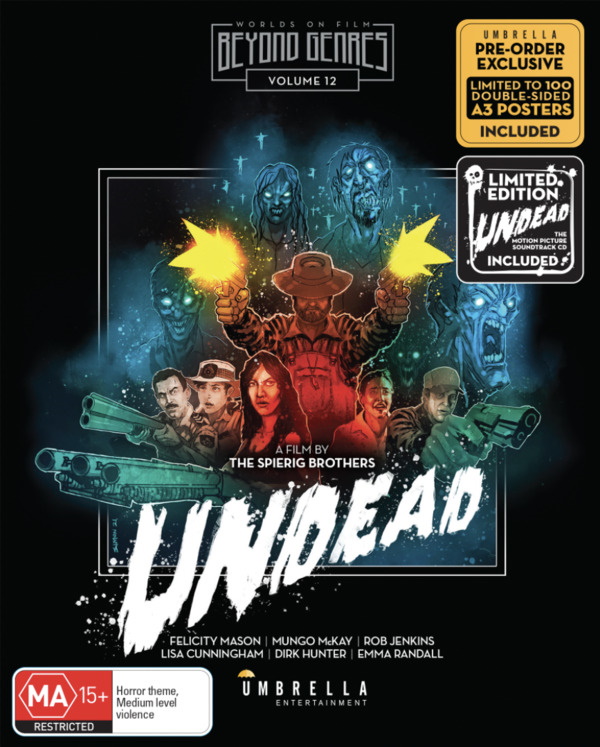
Umbrella Entertainment fears the UNDEAD (Review)

Australia attempts to wrest the the zombie comedy genre from New Zealand's Peter Jackson with UNDEAD, on Blu-ray from Umbrella Entertainment.

Having inherited a mountain of debt with her parents' family farm, Rene Chaplin (Felicity Mason) decides to sell up and, with the money netted from her win of "Miss Catch of the Day" at the local Berkeley fishing pageant, decides to quit the sticks for the city.  On the day she is set to leave – hitching a ride with the sleazy property agent (Steve Greig, CUT) – the town is hit by a series of meteors that have the side effect of transforming any one they contact into flesh-eating zombies.  Rene takes shelter in a farmhouse belonging to local loony Marion (Mungo McKay, INSPECTOR GADGET 2) who has been stocking up with guns and supplies ever since his cries of alien invaders and zombie fish went unheeded by the locals.  They are soon joined by pregnant Sallyanne (Lisa Cunningham) – still miffed at Rene for stealing her crown – and her cropduster pilot boyfriend Wayne (Rob Jenkins, PREDESTINATION), along with control freak constable Harrison (Dirk Hunter, RAIN FALL) and officer Molly (Emma Randall, AUSTRALIENS) in a fight for who is in charge and whether they are under alien attack or of its "just zombies."  The onslaught forces the six to flee the farm but a sinister kind of acid rain and lights that suddenly beam people and animals up into the sky suggest they have more to fear than just getting eaten.

Coming just before the early 2000s onslaught of independent zombie movies – of which maestro George Romero's DIARY OF THE DEAD and SURVIVAL OF THE DEAD were emblematic of rather than extraordinary exceptions – UNDEAD's zaniness feels more like an attempt to outdo Peter Jackson's DEAD ALIVE and BAD TASTE in one go as the everything-but-the-kitchen sink directorial debut of TV commercial and short subject filmmaking siblings Michael Spierig and Peter Spierig (whose most recent Hollywood breakout pics were the unfortunate JIGSAW and WINCHESTER).  Broadly-played from the start with splattery gore and awful (though impressive on the budget) CGI, the film's confused story stumbles along with the antics of the louder actors overshadowing any attempts at character development, and the set-pieces fewer and farther between as the film moves towards its climax in which the outsiders to Berkeley seem as enthusiastic to meet aliens as the soon-to-be-obliterated crowds of INDEPENDENCE DAY.  In its broad strokes, it has the ingredients of a cult film, and it achieved that status domestically and internationally – stateside with Lionsgate competing with Dimension Films' many zombie-related releases (including an anniversary DVD of NIGHT OF THE LIVING DEAD) – but for audiences of a certain age it may resemble a more ambitious and slickly-made take on the many zombie epics essayed or attempted by friends upon the releases of cinematic MiniDV cameras like the Canon XL-1 or the Panasonic DVX100.

Shot in Super 16mm and blown-up to 35mm, UNDEAD was released stateside by Lionsgate on DVD in a stacked special edition and much of the same extras appearing in various combinations internationally.  Umbrella's Blu-ray was preceded by a barebones Dutch edition from a 1080i50 master followed by a German edition that also utilized the 1080i master but was packed with extras.  Madman Entertainment gave Australia a 1080p edition with the two DVD comment and a full slate of extras, as well as a choice of two versions: the original cut (103:59) and the Lionsgate version (96:24) which made pacing trims.  

Working from a new 4K restoration supervised by the Spierig brothers, Umbrella's 1080p24 MPEG-4 AVC 1.78:1 widescreen Blu-ray only features the shorter cut (96:24), so presumably that was the cut they approved or the only one they had on film to restore.  The film's grading does not seem too revisionist, although the shadow detail under the blue filters applied to the day for night scenes may be better delineated than the previous master, and the deeper blacks may lend better shading to the CGI additions, but it will always be an inconsistent-looking film.  The DTS-HD Master Audio 5.1 and 2.0 tracks are rich with directional effects and the surrounds seem more ambitious than other films of this budget with plenty of omnipresent rainfall, spinning blades, gunfire, and explosions.  The English HoH subtitles, while free of errors, do fail to convey the manic intensity of some of the dialogue delivery even when in all caps.

The older editions featured two commentary tracks – the first with the Spierig brothers, cinematographer Andrew Strahorn, and special make-up effects artist Steven Boyle, and the second with actors McKay, Hunter, and Randall – while Umbrella has jettisoned those in favor of a new track by the Spierigs and Strahorn.  It is unfortunate that neither of the older commentaries were ported over – Lionsgate was able to fit them to the shorter cut for the US DVD edition – since the new track finds the trio lamenting on the fewer opportunities for risk and on-the-go thinking of their debut feature while also noting the amount of rehearsal and planning that had to go into making the film's 2:1 shooting ratio since the film stock was the most expensive component of the production on which the trio felt on an even keel with the mostly-inexperienced actors and other crew members who were especially willing to give the production their all once the brothers had quickly edited together some of the rushes to screen for everyone.

The rest of the extras are ported over from the earlier editions.  "On the Set of UNDEAD" (47:22) is an overview of the shoot with little commentary, focusing on the rehearsals, location shooting for some of the bigger scenes, stuntwork, and effects.  What is most interesting are the looks at where the sets give way to greenscreen as well as the DIY greenscreen shots captured on location (one wonders whether it was done to save on trying to recreate the location lighting, rain, and wind in a studio or out of just trying to shoot as much material on each shooting day as possible.  

"The Making of UNDEAD" (37:28) is a more traditional EPK piece with the Spierig brother discussing their early shorts, their love of horror films, other inspirations from westerns to John Woo, and the importance of enthusiasm over experience in mounting a feature project on a small budget.  The cast chip in occasionally, with Mason providing more backstory for her character than apparent in the finished film and McKay disussing his stunt work, while production designer Matthew Putland (GOLDSTONE) recalls running out of his department budget on the first day and depending on free and recycled resources to create eleven interior sets that had to convey character, and effects artist Boyle recalls initially planning for an hour and a half for each zombie make-up only to realize that was impractical when they were shooting multiple scenes with different zombies each day.  "Home Made Dolly Construction" (2:09) and "UNDEAD Camera and Make-up Tests" (1:45) are self-explanatory.

Before UNDEAD, the Spierigs produced a trio of short films starting with "Attack of the Undead" (37:25) which plays up the fifties sci-fi throwback angle with black and white photography but the bargain basement production values apparent in the opening give way to various practical and visual effects that are poorer than the ones in the feature but quite ambitious indie and low budget short films from the nineties.  The disc also includes a stills gallery (11:37) and the film's theatrical trailer (2:31).  Included in this limited edition package is a 17-track CD soundtrack that appears to reproduce the contents of the American 2005 La-La-Land Records disc.